
Case Studies
Andre Vega – Moody Nolan
- Written by: Jason Pafundi
- Produced by: Victor Martins & Nick Randall
- Estimated reading time: 6 mins
When Andre Vega speaks about the redevelopment of Boston’s historic White Stadium, he does so with the calm confidence of someone who has spent decades steering complex projects – and with the unmistakable voice of a former athlete who knows what it means to lead from the center of the huddle. As a senior project manager for Moody Nolan, the nation’s largest Black-owned architecture firm, Vega is guiding a once-in-a-generation transformation of a facility that has defined public school athletics in Boston for more than 80 years.

Andre Vega | Moody Nolan | Senior Project Manager
For him, the work is both professional and personal. It draws together his 30-plus years in architecture, his extensive experience designing collegiate and public-school athletic facilities, and the lessons learned from a lifetime of playing and coaching sports: discipline, communication, teamwork, and an unshakeable resolve to elevate the people around him.
“I grew up in athletics,” he says. “You don’t have to like everybody on the team, but you have to find a way to play together.”
That mindset now guides one of the city’s most visible civic projects.
Shaping a historic venue for a new era
Built in 1942, White Stadium has long been a home for Boston Public Schools athletics, but decades of deferred maintenance have left the facility in disrepair. A fire in the 1980s condemned one of its structures, and the surrounding community watched year by year as the stadium drifted further from its former vitality.
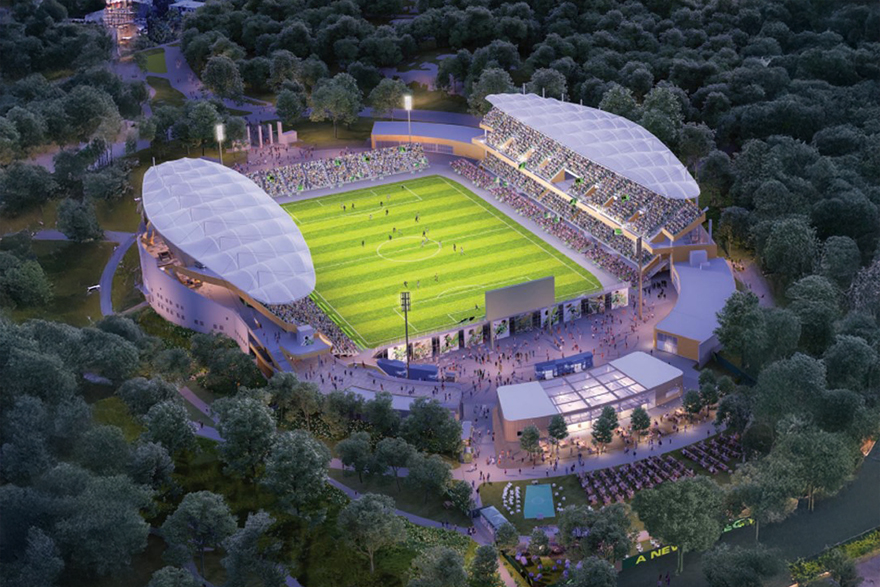
The current redevelopment, led on the west side by Stantec & Moody Nolan and on the east side by Jones Architecture in partnership with the City of Boston, aims to change that trajectory. The project will modernize the stadium for professional women’s soccer while preserving its essential role as a community and school hub. Once complete, the facility will host the city’s new women’s professional soccer team roughly 20 days a year. For the other 345 days, it will belong to Boston Public Schools and the surrounding neighborhoods.
For Vega, that balance is essential.
“When it comes to a project like this, in the heart of a Black and brown community, people need to feel like they’re being heard,” he says.
Boston’s complicated history with race and civic engagement isn’t lost on him. The legacy of forced busing in the 1970s and the decades of national attention that followed still shape public discourse today. Vega embraces that complexity, attending community meetings, listening closely to concerns, and communicating the project’s long-term benefits. While a small but vocal group has opposed the redevelopment, he notes that the teams behind the project have had over 90 public & neighborhood small group meetings to ensure residents have opportunities to ask questions, give input, and understand the vision.
The result, he believes, will be a facility that reflects the community’s goals as much as the city’s.
“We got involved because we felt like it was an opportunity to make something the community can be proud of,” he says.
And in many ways, that sense of shared ownership begins with the way Vega leads.
Leadership that mirrors the playing field
Before he managed multi-million-dollar architecture and construction projects, Vega was a multisport athlete who played basketball and football in high school, then basketball at Wentworth Institute of Technology, where both he and his wife scored more than 1,000 points and were inducted into the college’s Hall of Fame. He later picked up lacrosse, drawn to the sport’s intensity and the familiar footwork required of defenders. He connected his own children to youth lacrosse, continuing the cycle of teamwork and mentorship that shaped him.

Those experiences inform the way he approaches project management today.
“There are very few things in the real world that you do by yourself,” he says. “Every project I’ve been on has been part of a team.”
In architecture and construction, the team includes architects, project coordinators, engineers, consultants, contractors, and city agencies. As the project manager, Vega serves as the link among them. He oversees design development, manages schedules and budgets, coordinates among firms, leads meetings with city officials, and serves as the primary point of contact for the developers, Able Company. His responsibilities span schematic design, bid negotiations, and construction administration.
“Everything I ask our teammates to do is stuff I’ve done and can do,” he says.
That hands-on philosophy stems from his earliest co-op experience at a small firm that worked on K-12 public schools, where roles were flexible, and the team relied on a “chief cook and bottle washer” mentality. Vega learned to draft, design, troubleshoot, and execute, appreciating the importance of knowing every aspect of the work. Today, he expects – and inspires – the same adaptability from his teams.
“I like team members who are fluid, willing and able to jump in and do what needs to get done,” he says.
He also values humility, emphasizing that architecture is about building for others, not for personal recognition. Anyone can create a beautiful rendering, he explains; the real work is ensuring it stands, functions, and serves its community for decades.
Navigating complexity with clarity
The White Stadium project requires the kind of leadership Vega has honed over decades, including his six years overseeing construction management at Suffolk University, his early years designing athletic facilities, and now his work across Moody Nolan’s sports practice. The firm has earned national recognition for its work in basketball arenas, hockey facilities, soccer stadiums, and football and baseball venues, giving Vega a deep bench of expertise to draw from.

Athletic construction, he notes, has become something of an arms race. Amenities, technology, and design change rapidly, and universities use their facilities as key recruiting tools. Being budget-conscious while designing for future needs requires both intuition and experience. Designers must build flexibility into every space, anticipating upgrades and improvements before they are even imagined.
“You try to use the information we have, estimate what the needs are going to be in the future,” he says. “But you can only know so much.”
The White Stadium redevelopment adds additional layers of complexity. The project must support a professional women’s soccer franchise while expanding access for local schools. It requires environmental sensitivity, historic context, public transparency, and compliance with city regulations. And it demands clear communication across dozens of stakeholders with different interests.
That is where Vega’s steady, team-oriented leadership becomes invaluable. He convenes weekly meetings with the client, coordinates design revisions, manages construction documents, and ensures that every phase moves forward with precision. He also facilitates dialogue between Moody Nolan’s West Side team, Jones Architecture’s East Side team, the City of Boston, and the Boston Legacy Football Club, whose partnership helped bring the project to life.
Boston Mayor Michelle Wu, Vega says, deserves recognition for “thinking outside the box” to revitalize a facility that had been neglected for generations. By sharing costs, building civic partnerships, and committing to long-term community use, the administration helped create a blueprint that other cities may follow when tackling aging public assets.
“When it gets done, it is going to be something really special,” Vega says. “And it becomes an example for other cities to find creative solutions for renovating neglected areas.”
Building for the next generation
For Vega, the work is deeply fulfilling not just as an architect or a manager, but as someone committed to improving communities. With two sons in or recently graduated from college and a daughter who plays lacrosse at their alma mater, he sees firsthand how facilities shape the student and athlete experience. Those personal ties reinforce the importance of his work on projects like White Stadium, as well as his other current assignments, including a lab building for MIT and a stadium project for Delaware State University.

“What are we providing to the community?” he asks. “My role is a small part of bringing improvement to the community.”
That outlook reflects Moody Nolan’s broader mission. As a firm rooted in diversity, inclusion, and civic investment, it has spent decades designing spaces that uplift people and serve future generations. The White Stadium project aligns with that vision, blending professional sport, public education, and neighborhood revitalization into a single effort with long-lasting impact.
Vega knows that turning vision into reality requires the same qualities he once relied on as a captain on the court: trust, communication, and the belief that everyone has a role worth honoring. Leading the White Stadium project, he brings those lessons forward, shaping a facility built not only for games but for the community that will gather within its walls.
And just like any good team leader, he’s focused less on the spotlight and more on the win for everyone involved.
Showcase your feature on your website with a custom “As Featured in Blueprint” badge that links directly to your article!
Copy and paste this script into your page coding (ideally right before the closing


